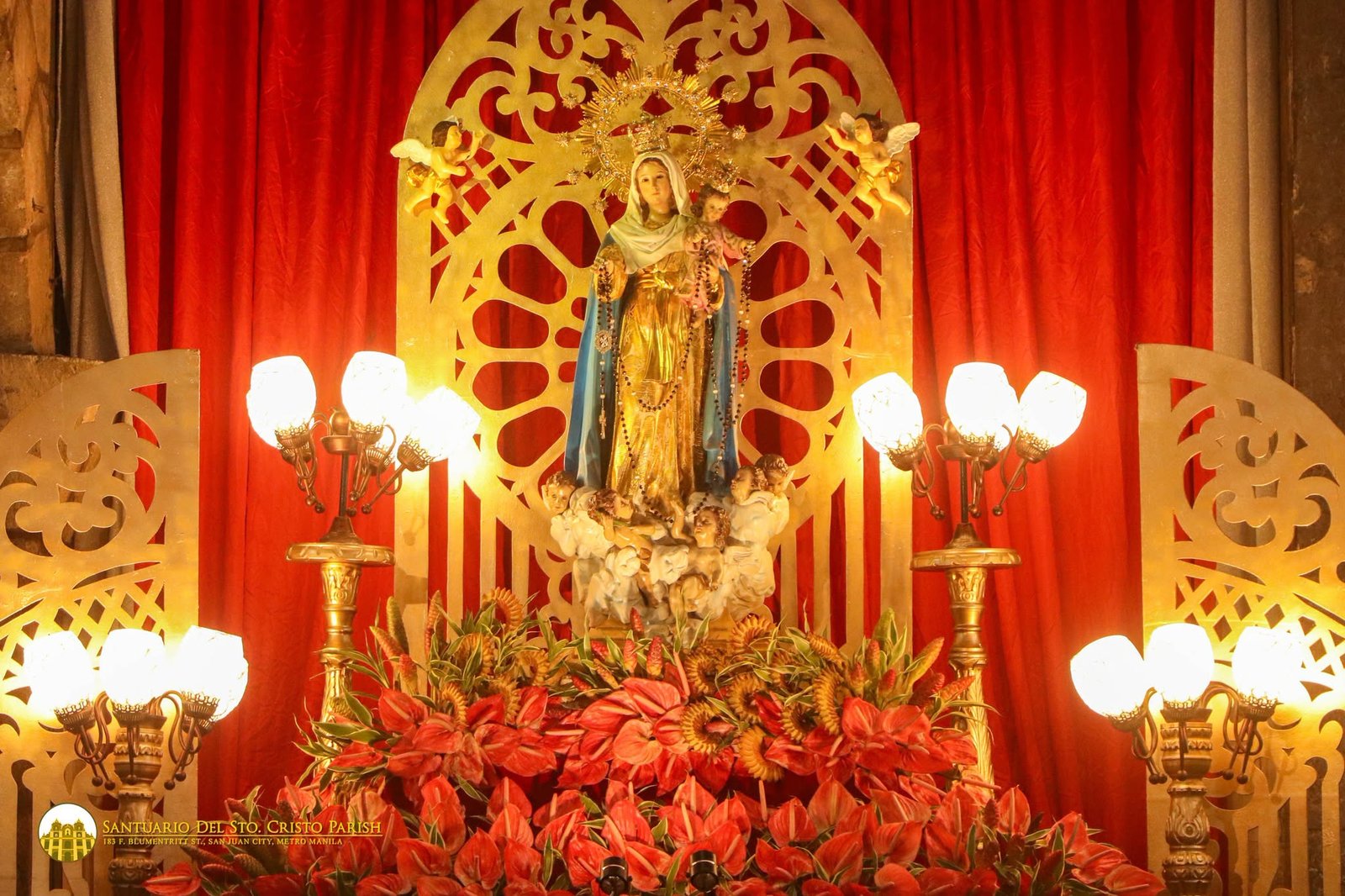
The title “Our Lady of the Most Holy Rosary” belongs to the Blessed Virgin Mary by virtue of her divine maternity, her intercessory power, and her explicit commission to the Order of Preachers to propagate the Rosary as a weapon of truth and grace. It is doctrinal, historical, and biblically grounded through the lens of Dominican tradition, papal authority, and the Catechism of the Catholic Church. And while this title is uniquely Dominican in origin and ecclesial structure, it has not gone unnoticed even by those outside the visible communion of the Church.
But let there be no mistake: the Rosary is not a museum piece. It is not a relic to be admired from afar. It is a
living sword.
A daily discipline. A school of holiness.
And no one understood this better than the saints who did not merely pray the Rosary, but became its living embodiment.
The Dominican Origin: St. Dominic and the Angelic Psalter
According to longstanding Dominican tradition, in 1208 (or 1214, per some sources), the Blessed Virgin Mary appeared to St. Dominic de Guzmán, founder of the Order of Preachers, in the church of Prouille in southern France. She handed him a Rosary, a150 Hail Marys divided into decades, each preceded by an Our Father and commanded him to preach it as a spiritual weapon against the Albigensian heresy, which denied Christ’s divinity and Mary’s role as Mother of God.

The Dominican Origin: St. Dominic and the Angelic Psalter
According to longstanding Dominican tradition, in 1208 (or 1214, per some sources), the Blessed Virgin Mary appeared to St. Dominic de Guzmán, founder of the Order of Preachers, in the church of Prouille in southern France. She handed him a Rosary, a150 Hail Marys divided into decades, each preceded by an Our Father and commanded him to preach it as a spiritual weapon against the Albigensian heresy, which denied Christ’s divinity and Mary’s role as Mother of God.

She told him: “Wonder not that you have obtained so little fruit by your labors… When God willed to renew the face of the earth, He began by sending down on it the fertilizing rain of the angelic salutation. Therefore, preach my psalter composed of 150 angelic salutations and 15 Our Fathers, and you will obtain an abundant harvest.”
This is not a legend invented for devotion but the foundational charism of the Dominican mission: to preach the Gospel with Mary’s prayer as its engine.
The Rosary became known as the “Psalter of Mary,” mirroring the 150 Psalms recited by monks, but accessible to the laity.
Dominic obeyed. He preached the Rosary relentlessly. Conversions followed. Heresies crumbled. The title “Our Lady of the Most Holy Rosary” emerged organically from this apostolic labor and not as a marketing slogan, but as a theological reality: Mary, through her Rosary, was actively defeating error and saving souls.
As St. Louis de Montfort later wrote: “All during life, Saint Dominic had nothing more at heart than to praise Our Lady, to preach her greatness and to inspire everybody to honor her by saying her Rosary.”

Dominic obeyed. He preached the Rosary relentlessly. Conversions followed. Heresies crumbled. The title “Our Lady of the Most Holy Rosary” emerged organically from this apostolic labor and not as a marketing slogan, but as a theological reality: Mary, through her Rosary, was actively defeating error and saving souls.
As St. Louis de Montfort later wrote: “All during life, Saint Dominic had nothing more at heart than to praise Our Lady, to preach her greatness and to inspire everybody to honor her by saying her Rosary.”

The Title Cemented: Lepanto and Pope Pius V
The title “Our Lady of the Most Holy Rosary” was officially liturgically recognized after the Battle of Lepanto on October 7, 1571. Pope St. Pius V – a Dominican, had called for public Rosary processions across Europe as the Christian fleet faced annihilation by the Ottoman Turks. Against all odds, victory was achieved.
Pius V declared the triumph attributable to the intercession of the Blessed Virgin through the Rosary. He instituted the feast of “Our Lady of Victory” on the first Sunday of October. Later, Pope Gregory XIII moved it to October 7, the anniversary of Lepanto and renamed it “Our Lady of the Most Holy Rosary.” Pope Paul VI confirmed this title universally in 1969.
Coincidence? Not at all – It is divine providence working through Dominican hands: a Dominican pope, a Dominican prayer, a Dominican title, ratified by the Church for the salvation of the world.
At Lepanto, the faithful flew to her protection and she delivered. Hence, “Our Lady of the
Rosary” is not merely a devotional nickname; it is a title earned in battle, sealed in blood, and confirmed by papal decree.

1. Mary as Intercessor: John 2:1–11 (Wedding at Cana)
Mary intervenes before her Son on behalf of others. Jesus responds—even when His “hour has not yet come.” This is the pattern of the Rosary: we ask Mary to present our petitions to Christ. CCC 969.
2. Mary as Model of Prayer: Luke 1:46–55 (Magnificat)
The Rosary is an echo of Mary’s own prayer. As John Paul II wrote: “It is an echo of the prayer of Mary, her perennial Magnificat.” To pray the Rosary is to sit at Mary’s school and learn to contemplate Christ.
3. Mary as Mother of the Church: John 19:26–27
From the Cross, Jesus gives Mary to John and to us, as mother. The Rosary is how we live out that filial relationship: praying with her, through her, to her Son. CCC 973.
4. The Power of Persistent Prayer: Luke 18:1–8 (Parable of the Widow)
The Rosary is persistent, repetitive, faithful prayer. It wears down heaven’s gates—not because God is reluctant, but because He desires our perseverance. Mary teaches us this.
The Catechism states plainly: “Mary’s function as mother of men in no way obscures or diminishes this unique mediation of Christ, but rather shows its power.” The Rosary does not replace Christ, it leads us to Him, through the hands of His Mother.
You can read my previous article on the Santuario Article Website.
Why Only Dominicans Can Claim This Title Authentically
Let there be no confusion: while all Catholics may pray the Rosary, the title “Our Lady of the Rosary” is intrinsically tied to the Dominican Order.
- Pope Leo XIII declared: “The Dominican Order… holds as its inheritance all that belongs to this
devotion.” - The chartering of Rosary Confraternities was an apostolic privilege reserved exclusively to the
Dominicans. - The uniform structure of the Rosary spread globally through Dominican preaching—
especially via Bl. Alan de la Roche, O.P., who established the first Rosary Confraternity in the
1470s. - The feast itself was instituted by a Dominican pope, commemorating a victory won through
Dominican-led prayer.


To detach “Our Lady of the Rosary” from the Dominicans is to strip it of its historical, theological, and ecclesial roots. It is like calling St. Thomas Aquinas “a random theologian” while ignoring his Dominican habit.
Why Only Dominicans Can Claim This Title Authentically
Let there be no confusion: while all Catholics may pray the Rosary, the title “Our Lady of the Rosary” is intrinsically tied to the Dominican Order.
- Pope Leo XIII declared: “The Dominican Order… holds as its inheritance all that belongs to this
devotion.” - The chartering of Rosary Confraternities was an apostolic privilege reserved exclusively to the
Dominicans. - The uniform structure of the Rosary spread globally through Dominican preaching—
especially via Bl. Alan de la Roche, O.P., who established the first Rosary Confraternity in the
1470s. - The feast itself was instituted by a Dominican pope, commemorating a victory won through
Dominican-led prayer.
To detach “Our Lady of the Rosary” from the Dominicans is to strip it of its historical, theological, and ecclesial roots. It is like calling St. Thomas Aquinas “a random theologian” while ignoring his Dominican habit.

Saints Who Lived the Title: Devotees of Our Lady of the Rosary
This title was not minted in marble, it was forged in the fires of sanctity. Below are saints whose lives prove that “Our Lady of the Rosary” is not a decoration, but a dynamo of grace.
1. St. Dominic de Guzmán (1170–1221) – Founder of the Order of Preachers
He received the Rosary directly from Mary’s hands. He preached it daily. He died with it in his hands. His entire order rests upon this foundation.
“The Rosary of Mary is, as it were, the principle and foundation on which the very Order of St. Dominic rests.” – Pope Pius XI
2. St. Pius V (1504–1572) – Dominican Pope, Architect of Lepanto
A former Grand Inquisitor and Master General of the Dominicans, he mobilized Christendom through the Rosary. At Lepanto, he knelt in prayer while the fleet sailed, not with swords alone, but with beads.
3. St. Louis de Montfort (1673–1716) – Dominican Tertiary, Apostle of Total Consecration
Though not a friar, he entered the Third Order of St. Dominic specifically to preach the Rosary more effectively. He called the Rosary “the secret of the saints” and wrote: “Let me but place my rosary around a sinner’s neck, and he will not escape me.”
His book The Secret of the Rosary remains the definitive Dominican manual on the devotion. He saw the Rosary not as repetition, but as meditation incarnate – Christ’s life, death, and glory, prayed through Mary’s eyes.
4. Bl. Alan de la Roche (c. 1428–1475) – Dominican Restorer of the Rosary
After the Rosary fell into neglect post-Dominic, Our Lady appeared to Bl. Alan and commanded him to revive the Confraternity. He preached the Rosary unceasingly and revived this Dominican devotion across Europe.
5. St. Catherine of Siena (1347–1380) – Lay Dominican, Doctor of the Church
Though she lived before the formal title “Our Lady of the Rosary,” she embodied its spirit. Her letters overflow with Marian theology rooted in contemplative prayer, the very essence of the Rosary.
6. St. Rose of Lima (1586–1617) – First Saint of the Americas, Lay Dominican
She prayed the Rosary with extraordinary perseverance and called the Rosary “my garden of delights.”
7. St. Martin de Porres (1579–1639) – Lay Dominican Brother
He joined prayer to works of mercy: serving the sick, feeding the poor, and placing his confidence in the Blessed Virgin.
8. St. Vincent Ferrer (1350–1419) – Dominican Preacher
He traveled Europe preaching penance and the Gospel. His ministry represents the Dominican union of contemplation, preaching, and conversion of life.

Non-Catholic Acknowledgment: Respect and Adaptation
No Protestant denomination officially celebrates the feast of “Our Lady of the Rosary” or accepts the Catholic invocation of Mary’s intercession. That distinction must be stated plainly. Nevertheless, some Anglicans, especially Anglo-Catholics, use forms of the Rosary, and some Lutherans use modified bead-prayers that retain meditation on the mysteries of Christ.
This is not agreement with Catholic doctrine. It is evidence that the Rosary’s structure – biblical scenes, the Lord’s Prayer, and disciplined contemplation can be recognized beyond the Catholic Church. Such usage does not establish the Marian doctrine of the Rosary; it does show that the devotion’s Christ-centered meditation is difficult to dismiss.


Pastoral Reflection: St. Louis de Montfort on Living the Devotion
If you want to know how to live the Rosary, not merely recite it, listen to St. Louis de Montfort. He wrote for ordinary Christians: sinners, the distracted, the poor, and those tempted to abandon prayer because it feels dry.
“The Rosary is the most powerful weapon to touch the Heart of Jesus, Our Redeemer, who so loves His Mother.”
His counsel is direct.

1. Pray it faithfully.
Do not wait until you feel devout. Establish a daily rule. If necessary, pray it in parts. Faithfulness matters more than emotional intensity.

2. Meditate; do not merely count.
The vocal prayers are not an escape from the mysteries. They support attention to Christ: his Incarnation, public ministry, Passion, Resurrection, and glory. The beads are a guide, not the destination.

3. Bring sinners to Christ.
A Rosary prayed only for oneself has been reduced. Intercede for those far from God, for the dying, for enemies, and for those who have no one to pray for them.

4. Let the mysteries correct your life.
The Annunciation demands obedience. The Visitation demands charity. The Crucifixion demands repentance and forgiveness. The Resurrection demands hope. If the Rosary does not change conduct, it has not yet been allowed to penetrate the heart.

5. Teach it by example.
Do not bully people into devotion. Pray it visibly, calmly, and consistently. Parents should let children see them pray. Preachers should explain the mysteries, not simply demand the practice.
The Rosary is not magic. Beads without faith, repentance, sacramental life, and obedience to Christ are only beads. But prayed with attention to the Gospel, under Mary’s maternal guidance, the Rosary forms Christians who know Christ, love Christ, and obey Christ.

Conclusion: Preach the Rosary. Defend the Title. Imitate the Saints.
“Our Lady of the Rosary” is not a soft, sentimental title. It is a battle cry, a doctrinal fortress, and a Marian mandate entrusted in Dominican tradition to preachers.
Pray it. Preach it. Defend it. But above all, live its mysteries. The Rosary has done its work when the person praying it becomes more obedient at Nazareth, more charitable at Ein Karem, more faithful at Calvary, and more hopeful at the empty tomb.
Sources noted in the original article: Catechism of the Catholic Church; Sacred Scripture; Dominican tradition concerning St. Dominic and the Rosary; Dominican sources on Bl. Alan de la Roche and Rosary confraternities; and St. Louis de Montfort, The Secret of the Rosary.
Written By:
Mr. JC Recto, OP
Lay Dominican